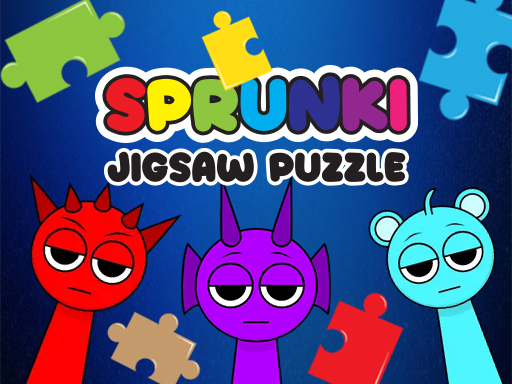
Discovering Sprunki Jigsaw Puzzle Game: More Than Just Pieces
Ah, jigsaw puzzles! They’ve been around for centuries, quietly sitting on our coffee tables, teasing our patience and rewarding our persistence. But then, along comes Sprunki Jigsaw Puzzle Game, a digital twist on the classic pastime, and suddenly your living room can be anywhere, your table can be your laptop, and your coffee can wait—because this game demands focus, fun, and just a dash of friendly competition.
I still remember the first time I clicked on Sprunki. “Drag and drop the pieces,” the tutorial said. Simple, right? Well… kind of. But as I soon realized, this game isn’t just about matching colors or fitting shapes. It’s a mini brain gym, a stress buster, and occasionally, a lesson in humility.
How Sprunki Works: Mechanics, Controls, and Objectives
Before we dive into strategies, let’s break it down. Think of this as your personal Sprunki GPS.
Game Mechanics:
- Drag and Drop: Move pieces from the tray to the puzzle board.
- Snap Feature: Pieces automatically “snap” into place when correctly aligned—lifesaver!
- Edge Detection: Pieces with straight edges naturally belong to the border.
- Zoom In/Out: Handy for larger puzzles or tiny, intricate pieces.
Controls:
- Mouse: Click, hold, drag, and release. Classic, precise, satisfying.
- Touchscreen: Tap, hold, and drag with a finger. Perfect for tablets or phones.
Objectives:
- Complete each puzzle image by correctly placing all pieces.
- Finish efficiently, but don’t forget to enjoy the process.
- Challenge your brain and memory—Sprunki subtly encourages this with color patterns and shape recognition.
Step-by-Step Strategy for Beginners
Let’s be honest: staring at a jigsaw puzzle can feel overwhelming. All those scattered shapes, all those colors—where do you even start? Here’s a friendly roadmap.
Step 1: Edge First, Always
Imagine walking into a room in the dark. You’d feel your way along the walls first, right? Same idea.
- Sort all edge pieces into a separate tray.
- Assemble the border first. This gives you a solid “frame” to work within.
Quick Tip: Group corners separately—they’re your natural anchors.
Step 2: Color and Pattern Recognition
- Sort pieces by dominant color or pattern.
- Create mini “color piles” on the tray.
Mini-Dialogue Moment:
Me: “Where does this turquoise piece go?”
My niece: “Look for the blue sky, silly!”
Me: “Ah… thank you, wisdom of youth strikes again.”
Step 3: Build Small Sections
- Start with easy, recognizable objects within the picture (a sun, a house, a tree).
- Connect these small sections to your border gradually.
Step 4: Fill in the Gaps
- Once you have edges and mini sections, the rest is a fun hunt.
- Rotate pieces mentally and try shapes even if colors aren’t a perfect match—sometimes our eyes deceive us.
Step 5: Celebrate Every Victory
Even finishing a small section is worth a high-five. Seriously, take a moment. You’ve earned it.
Advanced Strategies for Children, Parents, and Casual Players
Sprunki isn’t just for hardcore puzzle enthusiasts. Let’s talk strategies for different players.
Table 1: Player-Specific Approaches
| Player Type | Strategy Focus | Example Tip |
|---|---|---|
| Children | Fun and learning | Use colorful sections to teach colors, shapes, and patience. |
| Parents | Engagement and bonding | Play together, discuss the image, and assign “mini-missions” for kids. |
| Casual Players | Speed and enjoyment | Start with easier puzzles and gradually increase piece count. |
Anecdote: I once watched my nephew spend 20 minutes trying to fit a single red piece. The look of triumph when it clicked? Priceless. Sprunki teaches patience like a wise old mentor… in disguise.
Tips to Maximize Fun, Learning, and Success
Let’s be honest—Sprunki isn’t just about finishing the puzzle. It’s about the journey. Here’s how to get the most out of it.
Tip 1: Use a Consistent Workspace
- Clear your digital or physical workspace.
- Arrange pieces logically. Chaos is the enemy of focus.
Tip 2: Take Breaks
- Short breaks prevent frustration.
- Observe the image from a distance; your brain may notice missing connections subconsciously.
Tip 3: Encourage Storytelling
- For kids or family play, create stories around the image.
- Example: “Where do you think the little cat is going?”
Tip 4: Track Progress
- Use the timer sparingly—challenge yourself, but don’t obsess.
- Celebrate milestones, like completing 25%, 50%, 75% of the puzzle.
Detailed Gameplay Tactics: Step-by-Step
Here’s a structured approach for tackling any Sprunki puzzle, from beginner to pro.
Table 2: Puzzle Solving Workflow
| Stage | Action | Objective |
|---|---|---|
| Stage 1: Sorting | Separate edges, corners, and center pieces | Easier assembly, visual clarity |
| Stage 2: Borders | Assemble frame | Define puzzle space |
| Stage 3: Sections | Identify key objects and patterns | Build confidence and momentum |
| Stage 4: Color Piles | Group similar colors for quick reference | Faster piece identification |
| Stage 5: Assembly | Connect sections and fill gaps | Complete puzzle efficiently |
| Stage 6: Review | Zoom out to check placement | Ensure accuracy and completeness |
Mini-Story: When Strategy Meets Reality
I remember tackling a 500-piece puzzle of a bustling street scene. I had everything planned: edges, color piles, mini sections. And yet, there was this one stubborn piece. I tried every angle, every orientation. My son peeked over:
“Mom, maybe it’s a magic piece. It wants to hide.”
We laughed, tried a new approach, and eventually, that “magic piece” clicked perfectly. Moral? Patience, perspective, and a sense of humor are your best puzzle partners.
Sprunki Jigsaw Tips for Memory and Cognitive Growth
Beyond fun, Sprunki subtly boosts mental skills. Here’s why:
- Pattern Recognition: Your brain learns to identify shapes and colors faster.
- Spatial Awareness: Visualizing how pieces fit improves 3D thinking.
- Memory Skills: Remembering where pieces go strengthens recall.
- Problem-Solving: Encountering difficult sections teaches perseverance.
Pro Tip: Encourage children to verbalize their thought process: “This piece is too blue for the tree, maybe it belongs to the sky.” It’s a mini cognitive workout!
Maximizing Speed Without Sacrificing Fun
Sometimes, we want speed, but speed without joy is just… stress. Here’s how to balance both:
Table 3: Speed vs Fun Strategy
| Objective | Approach | Notes |
|---|---|---|
| Fast completion | Start with edges, group colors, small sections | Avoid random guessing |
| Enjoyment first | Focus on storytelling, celebrate small wins | Speed is secondary |
| Mixed approach | Alternate timed sessions with relaxed play | Keeps excitement and skill growth balanced |
Interactive Engagement Ideas
Sprunki is perfect for group or family play. Try these:
- Puzzle Races: Who completes their section first?
- Piece Swap Challenge: Each player can only use pieces from another’s tray.
- Story Creation: Build a story from the completed image; add dialogue, names, and fun twists.
Fun Fact: Adults often forget that games like this ignite imagination just as much as kids. Last weekend, I watched two adults debate if a small red door in a puzzle led to Narnia. Spoiler: it did, in our story.
Encouraging Young Players: Patience and Pride
For children, Sprunki is not just a game—it’s a confidence builder.
- Start with simple puzzles (20–50 pieces).
- Praise effort over speed.
- Encourage them to explain why a piece fits.
Mini-Dialogue:
Me: “Why did you put the blue piece there?”
Kid: “Because it looks like the sky!”
Me: “Exactly! See, your brain is already a mini genius.”
Celebrating these tiny triumphs is as important as completing the whole puzzle.
Common Mistakes and How to Avoid Them
Even seasoned players slip up. Here’s the cheat sheet:
- Mistake 1: Starting randomly without edges → slows progress
- Mistake 2: Ignoring color patterns → confusion in mid-assembly
- Mistake 3: Rushing → misplaced pieces, frustration
- Mistake 4: Neglecting mini-sections → missing strategic advantage
Quick Fix: Always start structured, group by color/edge, and take mini-breaks.
Social Media Sharing: Show Off Your Sprunki Success
Sharing your Sprunki achievements can be just as satisfying as solving the puzzle itself.
- Snap a photo of your completed puzzle.
- Share your “behind the scenes” setup or color piles.
- Include hashtags to join the community:
Suggested Hashtags:
#SprunkiPuzzle #JigsawFun #PuzzleMaster #FamilyGaming #BrainBoost #PuzzleChallenge #DigitalJigsaw #MindfulGaming
Tip: Share funny or unexpected moments—like that “magic piece” story. People love authenticity.
Final Thoughts: Why Sprunki Jigsaw Puzzle Game Matters
In the end, Sprunki is more than a game. It’s a way to unwind, bond, laugh, and challenge yourself. It’s that rare digital experience that still brings the tactile joy of a real puzzle, just without the risk of pieces scattering under the couch.
Whether you’re a parent, a child, or a casual player, the strategies above ensure that you not only complete puzzles faster but savor every click, every placement, every tiny victory. And remember—sometimes, a piece doesn’t fit immediately. Sometimes, the journey to find it is the real reward.
So drag, drop, laugh, and repeat. Your next puzzle victory is just a piece away.
About the Author