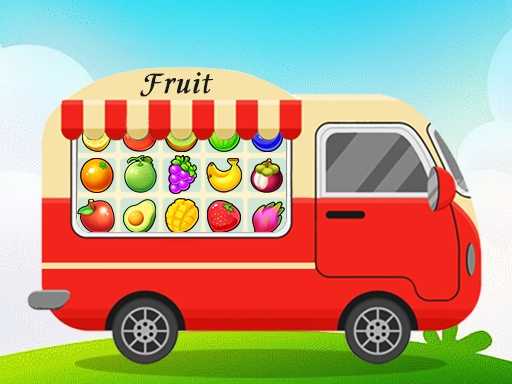
Game Overview
This engaging fruit-sorting puzzle game challenges your strategic planning, organization, and decision-making skills across a board of nine card slots. Each slot can hold up to twelve fruits, and various fruit types appear randomly throughout the game. Your mission is to arrange and manage these fruits efficiently so that each slot fills with identical fruit types. Once a slot contains twelve matching fruits, a truck arrives to transport them away—counting as one transportation trip toward your victory target.
Every move matters. Because fruit types appear unpredictably, the game requires thoughtful slot allocation, forward planning, and the ability to adapt quickly when the board becomes crowded. Success comes from balancing immediate tactical choices with a long-term strategy for managing space and maximizing transportation sequences.
At the time of writing, there is no dedicated Wikipedia page for this game.
Core Gameplay Experience
You control a set of nine card slots, each functioning as a container with a maximum capacity of twelve fruits. Fruits appear one by one, and you decide which slot to place each fruit into. Filling a slot with twelve fruits of the same kind triggers a transportation truck that removes the entire stack, freeing the slot for future fruits.
Because fruits are generated randomly, players must:
-
Manage limited space
-
Predict emerging fruit patterns
-
Avoid clogging slots with mismatched combinations
-
Maintain room for new fruit types
-
Strategically group identical fruits to reach full capacity
The challenge gradually intensifies as slots fill up and fewer available spaces remain. The ultimate goal is to complete the required number of transportation trips before the board becomes too cluttered.
Complete Gameplay Strategies
Below are comprehensive strategies to help you plan efficiently, manage slots effectively, avoid deadlocks, and achieve your transportation goals with ease.
Strategy 1 – Slot Allocation and Early-Game Planning
Early decisions often determine whether you’ll achieve later success. Proper slot allocation prevents a chaotic board and sets a strong foundation.
Early-Game Principles
-
Assign each beginning slot a specific fruit type as soon as you detect a pattern.
-
Avoid placing more than two types of fruits in the same slot early on.
-
Keep at least one slot completely empty as a “buffer zone.”
-
Build stacks evenly to avoid having several nearly-full but mismatched slots.
Table: Slot Allocation Strategy
| Tip | Action | Reasoning |
|---|---|---|
| Designate early fruit slots | Assign fruit types to slots as they appear | Prevents random mixing and future blockage |
| Use a buffer slot | Keep one slot empty for emergencies | Allows temporary storage during rearranging |
| Build gradually | Spread placement across slots | Avoids creating near-full mismatched stacks |
| Limit fruit variety per slot | Keep each slot specialized | Simplifies later matching and transportation |
Strategy 2 – Mid-Game Organization and Consolidation
As the game progresses, the board fills and fruit management becomes more complex. Efficient consolidation becomes crucial.
Mid-Game Tactics
-
Start merging partial stacks to create larger, unified groups.
-
Move mismatched fruits into the buffer slot temporarily.
-
Prioritize finishing nearly-complete stacks to free slots quickly.
-
Watch for fruit types that are appearing frequently and prioritize them.
Table: Mid-Game Optimization Strategy
| Tip | Action | Reasoning |
|---|---|---|
| Merge partial stacks | Combine same-type fruits from different slots | Creates space and speeds up transportation |
| Use buffer smartly | Store mismatched fruits temporarily | Allows better reorganization |
| Complete near-full stacks | Focus on finishing slots close to 12 | Frees entire slots for reuse |
| Track fruit frequency | Focus on high-appearance fruits | Increases transportation speed |
Strategy 3 – Avoiding Board Lock and Overflow
A full board with mismatched slots can lead to instant failure. Preventing overflow is essential to success.
Preventing Deadlocks
-
Never allow more than three slots to contain more than three fruit types.
-
Regularly clear slots rather than building multiple messy stacks.
-
Keep mid-size stacks organized (4–7 fruit range).
-
Plan ahead for rare fruit types that may take longer to group.
Table: Deadlock Prevention Strategy
| Tip | Action | Reasoning |
|---|---|---|
| Limit multi-type slots | Keep fruit types per slot to a minimum | Reduces clutter and confusion |
| Clear slots early | Complete transports whenever possible | Prevents the board from becoming overcrowded |
| Manage mid-size stacks | Keep them clean and unified | Mid-range stacks are easiest to fix or finish |
| Plan for rare fruits | Store them safely for future matches | Prevents rare fruits from clogging slots |
Strategy 4 – Late-Game Efficiency and Transportation Maximization
Late-game strategy focuses on clearing slots quickly and making the most of limited space.
Endgame Techniques
-
Focus exclusively on nearly-complete stacks.
-
Avoid starting new fruit types unless absolutely necessary.
-
Keep two slots always “in progress” for fastest rotation.
-
Move fruits proactively before the board becomes too tight.
Table: Endgame Transportation Strategy
| Tip | Action | Reasoning |
|---|---|---|
| Prioritize completion | Finish stacks close to 12 first | Frees slots quickly for new fruit generation |
| Limit new fruit types | Work mainly with established stacks | Reduces complexity at high board density |
| Keep rotation slots | Maintain two active filling slots | Maximizes transportation rate |
| Rearrange proactively | Move pieces before slots fill | Prevents crisis-level overcrowding |
Strategy 5 – Managing Randomness and Adapting on the Fly
Since fruits appear randomly, adaptability is a major part of victory.
Adaptation Methods
-
Watch patterns across several fruit drops to predict clustering.
-
Rearrange stacks only when you’re certain it will pay off.
-
Use the buffer slot as a flexible solution to sudden mismatches.
-
Shift strategy instantly if a new fruit type becomes dominant.
Table: Adaptation Strategy
| Tip | Action | Reasoning |
|---|---|---|
| Track trends | Identify which fruits appear often | Helps prioritize correct stacks |
| Rearrange wisely | Don’t rearrange without a purpose | Prevents unnecessary overcrowding |
| Keep buffer flexible | Use buffer slot for dynamic changes | Maintains control during randomness |
| Shift focus as needed | Adapt when fruit appearance changes | Ensures efficient use of each slot |
Strategy 6 – High-Level Efficiency Techniques
For advanced players who want to optimize every move, these techniques help maintain maximum efficiency.
Expert-Level Strategies
-
Pre-plan fruit type assignments based on probability.
-
Maintain multiple “almost full” slots to speed up successive transports.
-
Count remaining fruit space to avoid overfilling.
-
Transition smoothly from one completed transportation to the next.
Table: Expert Efficiency Strategy
| Tip | Action | Reasoning |
|---|---|---|
| Use probability planning | Predict which fruits will reappear | Creates long-term slot organization |
| Prep nearing-complete slots | Keep several stacks at 10–11 fruits | Enables rapid back-to-back transports |
| Track capacity | Pay attention to remaining space | Prevents accidental overcrowding |
| Maintain transport chain | Complete transports in sequence | Maximizes score and momentum |
General Tips for All Players
Whether you’re new or experienced, these universal guidelines will help you excel in this fruit-sorting challenge:
-
Don’t panic when the board fills—focus on organization.
-
Keep fruit types grouped logically from the beginning.
-
Always save at least one slot for emergency rearranging.
-
Focus on consistency rather than rushing.
Final Thoughts
This fruit-sorting card slot game blends puzzle elements, resource management, and strategic planning into an addictive and rewarding experience. With nine slots, random fruit generation, and capacity-based transportation mechanics, the game challenges your organizational skills at every turn. Although there is no dedicated Wikipedia page, this guide equips you with the strategies needed to arrange fruits efficiently, prevent deadlocks, and reach your target number of transportation trips.
Master slot allocation, maintain a buffer, predict fruit patterns, and manage your stacks wisely—do this, and you’ll steadily work your way toward victory, one truckload at a time.
About the Author