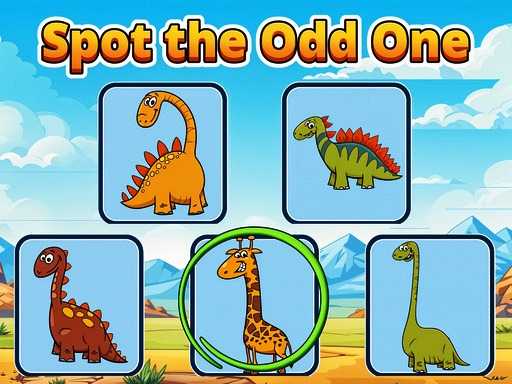
A Gentle Invitation to Look Closer
Let me start with a familiar moment.
You’re looking at a screen full of cheerful cartoons. Everything looks the same—until it doesn’t. One tiny detail feels… off. Your finger hovers. You smile. There it is.
That quiet “aha!” moment is the heart of Spot the Odd One.
This game doesn’t shout for attention. It whispers, Look again. And somehow, that whisper turns into laughter, curiosity, and a surprisingly strong desire to improve. Whether you’re a child discovering patterns, a parent playing alongside, or an adult enjoying a calm mental challenge, Spot the Odd One feels like a friendly puzzle buddy sitting right next to you.
Let’s talk about everything this game offers—how it works, why it’s so satisfying, and how to become wonderfully good at spotting what doesn’t belong.
Understanding the Core Idea of Spot the Odd One
The concept is beautifully simple:
-
You’re shown a group of pictures
-
Most of them match
-
One picture is different
-
You tap the odd one
That’s it.
But simplicity doesn’t mean shallow. As levels progress, the differences become more subtle. Colors shift slightly. Shapes change quietly. Expressions vary just enough to test your attention.
The game grows with you, which is why it feels playful instead of repetitive.
Controls: As Easy as Point and Tap
The game removes all technical barriers so your mind can focus entirely on observation.
How You Play
-
Use a mouse or touchpad
-
Tap or click on the picture that doesn’t match
No timers screaming at you. No complicated gestures. Just observation and choice.
This accessibility makes Spot the Odd One ideal for:
-
Young children
-
Family play sessions
-
Relaxed solo challenges
The Real Objective (Beyond Just “Winning”)
On paper, the goal is to identify the odd image correctly.
In practice, the goal is sharper focus.
Each level quietly trains you to:
-
Notice small details
-
Compare objects carefully
-
Slow down impulsive reactions
-
Trust your perception
It’s less about speed and more about seeing.
Why This Game Feels So Friendly
The visuals matter—a lot.
Spot the Odd One uses colorful cartoons, friendly shapes, and playful designs. Even when you make a mistake, the game doesn’t punish you harshly. Instead, it invites you to try again.
I’ve watched kids laugh at wrong answers and adults nod thoughtfully at correct ones. That emotional balance is intentional—and effective.
Beginner Strategy: Learning How to Look
If you’re new, here’s the most important advice I can offer:
Don’t scan. Compare.
Step-by-Step Beginner Approach
-
Pick one image as your “reference”
-
Compare each other image to it
-
Look for one change at a time (color, shape, detail)
-
Only tap when you’re sure
Rushing leads to guessing. Comparing leads to learning.
Strategy Table: Beginner Observation Skills
| Focus Area | What to Look For | Common Mistake |
|---|---|---|
| Color | Slight shade differences | Assuming colors match |
| Shape | Missing or extra parts | Looking too generally |
| Expression | Eyes, mouths, posture | Ignoring faces |
This slow method may feel careful—but it builds confidence fast.
The Psychology of “Almost the Same”
As levels advance, the game plays a clever trick: it makes everything feel identical.
That’s when frustration can sneak in.
Here’s a gentle reminder:
The odd one is always there.
Your job isn’t to panic—it’s to trust that something is different.
Mid-Level Strategy: Divide and Conquer
Once puzzles become more complex, scanning everything at once gets tiring. Instead, divide your attention.
How to Break the Grid Mentally
-
Top row first
-
Then bottom row
-
Left to right
By limiting your focus, your brain relaxes—and details pop out more easily.
Strategy Table: Grid Scanning Techniques
| Technique | Best For | Why It Works |
|---|---|---|
| Row-by-row | Large grids | Reduces overwhelm |
| Feature-by-feature | Subtle differences | Isolates details |
| Pair comparison | Similar images | Highlights contrast |
I’ve solved many tricky levels simply by saying, “Okay, just the eyes now.”
Common Differences You’ll Encounter
Understanding what the game likes to change gives you an advantage.
Frequently Used Oddities
-
Slight color mismatches
-
Missing accessories
-
Extra lines or dots
-
Altered facial expressions
-
Reversed shapes
Once you recognize these patterns, your confidence grows quickly.
Strategy Table: Difference Types and Detection Tips
| Difference Type | Detection Tip |
|---|---|
| Color shade | Squint slightly |
| Missing object | Count elements |
| Extra detail | Scan edges |
| Facial change | Focus on eyes |
| Orientation | Check direction |
Spotting differences becomes a skill—not luck.
Emotional Moments Every Player Recognizes
There’s a very specific feeling when you stare too long.
Your brain says, They’re all the same.
Your gut says, No, one is wrong.
And when you finally see it?
That tiny burst of pride feels surprisingly good.
That’s why this game keeps pulling people back.
Playing With Children: Turning Fun Into Learning
Spot the Odd One is a wonderful shared experience.
Gentle Ways to Guide Kids
-
Ask what looks “funny” or “different”
-
Encourage explaining their choice
-
Celebrate effort, not just correctness
It builds observation and communication skills without feeling like practice.
Advanced Strategy: Feature Isolation
For harder levels, advanced players isolate features intentionally.
Instead of asking, Which picture is odd?
Ask, Which eye is different? Which color? Which shape?
This technique turns confusion into clarity.
Strategy Table: Advanced Feature Isolation
| Feature | Why Focus Here |
|---|---|
| Eyes | Often subtly altered |
| Accessories | Easy to overlook |
| Borders | Slight shape changes |
| Color patterns | Trick the brain |
Advanced players don’t look harder—they look smarter.
Managing Fatigue and Frustration
Observation fatigue is real.
If you feel stuck:
-
Blink
-
Look away briefly
-
Return with fresh eyes
Many answers reveal themselves after a short pause.
I’ve solved levels simply by leaning back and smiling at the screen again.
Time Pressure vs Calm Focus
Some players try to answer quickly. Others slow down.
Here’s the truth:
Accuracy improves with calm.
Speed naturally follows accuracy—not the other way around.
Strategy Table: Calm vs Rushed Play
| Play Style | Result |
|---|---|
| Rushed | More mistakes |
| Calm | Clearer vision |
| Focused | Consistent success |
The game rewards patience more than reflexes.
Why Adults Love This Game Too
It’s relaxing without being boring.
No loud sounds.
No stress.
Just gentle mental engagement.
It’s perfect for short breaks, quiet evenings, or moments when you want to feel clever without feeling pressured.
Long-Tail Search Phrases Players Often Look For
Players often search for:
-
“Spot the odd one game tips for kids”
-
“How to improve observation skills games”
-
“Find the odd picture strategy”
And the answer is always the same: slow down, compare carefully, and enjoy the process.
Mistakes Everyone Makes (And How to Fix Them)
| Mistake | Why It Happens | Friendly Fix |
|---|---|---|
| Guessing | Impatience | Compare one feature |
| Overthinking | Visual overload | Simplify focus |
| Tunnel vision | Fixating on one area | Reset scan |
Mistakes here aren’t failures—they’re part of sharpening your eye.
Why Spot the Odd One Stays Enjoyable
Because it respects the player.
It doesn’t rush you.
It doesn’t confuse you unfairly.
It trusts that you can see the difference.
That trust feels good.
Final Thoughts: The Joy of Noticing
Spot the Odd One reminds us of something simple and powerful:
Details matter.
In a world that moves fast, this game asks you to pause, look, and notice. And when you do, it rewards you with that quiet, satisfying click of understanding.
Sometimes, that’s all a good game needs to do.
Share the Fun on Social Media
Found a tricky odd one? Played with family? Share the joy of noticing the little things.
Suggested Hashtags:
#SpotTheOddOne
#ObservationGame
#BrainFun
#PuzzlePlay
#FamilyFriendlyGames
#VisualChallenge
#TapToThink
Because sometimes, the smallest difference makes the biggest smile 😊🧠🎨