Game Overview
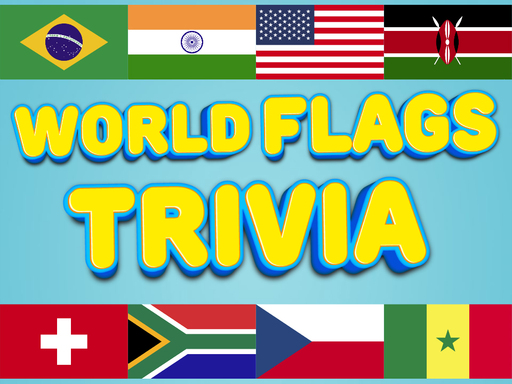
World Flags Trivia invites players into an engaging, fast-paced geography challenge designed to test memory, recognition, and global awareness. Featuring 100 questions spanning flags from every corner of the world, the game tasks you with identifying each nation correctly from three multiple-choice options. At first glance, the concept may appear simple—select the correct answer and move on—but as you advance through the quiz, the flags become increasingly similar, more obscure, and trickier to distinguish, transforming the experience from casual fun into a true test of skill.
Visually bold and educational at its core, World Flags Trivia blends entertainment with learning, making it appealing to students, travel lovers, and trivia enthusiasts alike. Each question introduces a new national flag, encouraging players to note patterns, colors, shapes, and symbols that define each country’s identity. A perfect score becomes a badge of honor, a testament to sharp observation and a growing understanding of world cultures.
As players progress, they begin recognizing the subtle differences between flags that share similar palettes or designs—parallel stripes, the orientation of stars, the presence of crests, or precise shade variations. Every correct answer reinforces memory, while every slip creates an opportunity to learn and refine strategy for future attempts. Whether you’re playing casually or aiming for mastery, World Flags Trivia encourages thoughtful attention, pattern recognition, and long-term retention.
To explore general gameplay principles from similar trivia and puzzle genres, readers can consult Webedia’s gameplay guide:
https://www.webedia.com/gameplay-guide.
With simple mouse or touchpad controls, clean visuals, and a rewarding progression curve, World Flags Trivia delivers an enjoyable balance of education and challenge that keeps players returning for one more attempt at that elusive perfect score.
Complete Gameplay Strategies
Although the game’s mechanics appear straightforward, achieving high accuracy across 100 questions requires strategy, focus, and a structured approach. Below are detailed methods for improving performance, avoiding common mistakes, and sharpening your flag-identification abilities over time.
Strategy 1: Recognizing Flag Patterns and Categories
The most effective way to boost your performance in World Flags Trivia is by learning how flags can be grouped based on color schemes, structure, and symbols. Many nations share visual themes—horizontal tricolor stripes, central emblems, geometric shapes—which makes categorization an essential skill.
Key Concepts
-
Pattern classification accelerates recognition.
-
Shared color themes often relate to regional history.
-
Shapes and symbols serve as quick identifiers.
Practical Tips
-
Memorize common regional color patterns (e.g., Pan-African, Pan-Arab).
-
Identify unique icons such as suns, crests, eagles, and stars.
-
Pay attention to flag symmetry, stripe order, and emblem placement.
-
Note how similar pairs differ (e.g., orientation, hue, or symbol count).
Table – Pattern Recognition Strategy
| Tip | Action | Reasoning |
|---|---|---|
| Group flags mentally | Categorize flags by stripes, symbols, and colors | Speeds pattern recognition under time pressure |
| Focus on unique features | Identify one defining element per flag | Helps differentiate similar designs |
| Study regional themes | Note common palettes within continents | Builds intuitive recognition skills |
| Compare confusing flags | Analyze pairs like Indonesia vs. Monaco | Reduces errors on nearly identical designs |
Strategy 2: Using Color Psychology and Memory Anchors
Color is one of the most powerful assets in World Flags Trivia. Many flags share similar hues, but each uses them differently. By pairing colors with memory anchors—mental cues—you strengthen recall and improve speed.
Key Concepts
-
Color anchors improve long-term memory.
-
Shades and tones matter just as much as colors.
-
Associating colors with culture or geography boosts retention.
Practical Tips
-
Link flag colors to national characteristics (e.g., green for lush landscapes).
-
Identify flags using dominant vs. accent colors.
-
Use mnemonic devices to remember stripe order.
-
Pay special attention to flags with rare colors like purple or turquoise.
Table – Color Strategy
| Tip | Action | Reasoning |
|---|---|---|
| Create color associations | Tie colors to cultural or geographic features | Improves memory retention |
| Note unusual hues | Memorize flags with rare color use | Helps quickly eliminate incorrect choices |
| Remember order of stripes | Use mnemonics for top-to-bottom patterns | Prevents mixing similar tricolor flags |
| Focus on color balance | Compare dominant vs. minor colors | Enhances accuracy when designs overlap |
Strategy 3: Eliminating Distractors in Multiple-Choice Answers
With only three options per question, you can often deduce the correct answer even without perfect knowledge. World Flags Trivia rewards players who use process of elimination intelligently.
Key Concepts
-
Distractor answers are often deliberately similar.
-
Incorrect choices may differ slightly in region or color.
-
Eliminating options rapidly boosts accuracy.
Practical Tips
-
Remove choices that don’t match the region suggested by the flag’s design.
-
Identify which answer seems too visually different from the others.
-
Use knowledge of popular flags to eliminate them when they don’t belong.
-
Recognize tricky options built to mimic the correct flag.
Table – Elimination Strategy
| Tip | Action | Reasoning |
|---|---|---|
| Scan all choices first | Compare options before answering | Helps detect distractors quickly |
| Eliminate out-of-region flags | Remove answers from unrelated continents | Reduces incorrect guesses |
| Look for subtle differences | Focus on stripe direction, symbol shape, color tone | Identifies nearly identical trick flags |
| Use educated guessing | Employ partial knowledge to narrow choices | Improves odds when uncertain |
Strategy 4: Building Long-Term Flag Memory
Progressing through 100 questions encourages repeated exposure, which is ideal for structured learning. The key is turning that repetition into intentional memorization.
Key Concepts
-
Active recall outperforms passive recognition.
-
Reviewing mistakes strengthens memory.
-
Incremental progress leads to mastery.
Practical Tips
-
After each run, review questions you answered incorrectly.
-
Group flags by continent and study them in batches.
-
Reattempt the quiz regularly to reinforce knowledge.
-
Practice identifying flags outside the game for better retention.
Table – Memory-Building Strategy
| Tip | Action | Reasoning |
|---|---|---|
| Review incorrect answers | Examine mistakes after each session | Converts errors into learning opportunities |
| Study by region | Learn flags continent by continent | Reduces information overload |
| Re-play frequently | Repeat attempts to strengthen recognition | Builds automatic recall |
| Learn beyond the game | Explore maps and flag lists offline | Deepens long-term memory skills |
Strategy 5: Managing Focus and Pacing During Long Sessions
With 100 consecutive questions, World Flags Trivia becomes a test of concentration as much as knowledge. Maintaining mental clarity from start to finish is essential.
Key Concepts
-
Fatigue increases mistakes.
-
Consistent pacing reduces rushed decisions.
-
Short breaks can refresh mental accuracy.
Practical Tips
-
Avoid rushing through familiar flags—stay consistent.
-
Take a brief break if you feel your concentration slipping.
-
Use deep breathing to maintain focus during difficult streaks.
-
Keep track of which parts of the quiz challenge you most.
Table – Focus Strategy
| Tip | Action | Reasoning |
|---|---|---|
| Pace your answers | Maintain steady, controlled input | Prevents impulsive mistakes |
| Take short mental resets | Pause briefly every 20–30 questions | Refreshes cognitive focus |
| Identify difficult zones | Note which flag types challenge you most | Helps target weak areas |
| Stay calm during streaks | Regulate breathing and avoid panic | Improves decision accuracy |
Strategy 6: Preparing for Similar-Looking Flags
Many nations have flags that closely resemble one another. These are the “trick” questions where strategy matters most.
Key Concepts
-
Small details make big differences.
-
Some flags vary only in stripe width or order.
-
Recognizing micro-details prevents costly errors.
Practical Tips
-
Memorize signature differences between famous pairs (e.g., Chad vs. Romania).
-
Look closely at emblem placement—left, centered, or absent.
-
Check star count and arrangement when applicable.
-
Compare color saturation—some flags use darker or lighter tones.
Table – Similar Flags Strategy
| Tip | Action | Reasoning |
|---|---|---|
| Identify “twin flags” | Learn pairs with nearly identical designs | Reduces mistakes on known trick questions |
| Examine emblems carefully | Look for crests, stars, or symbols | Small details confirm identity |
| Note stripe order | Study vertical vs. horizontal patterns | Prevents quick misidentification |
| Compare color shades | Distinguish between light and dark tones | Helps when designs are nearly identical |
Final Thoughts
World Flags Trivia is more than a simple guessing game—it’s a compelling blend of learning, strategy, and global awareness that rewards patience, memory, and thoughtful observation. With 100 questions designed to sharpen your recognition skills, the game offers an engaging journey through the colors, symbols, and histories of nations around the world.
Whether you’re aiming to improve your geography knowledge, challenge your memory, or simply enjoy a visually striking trivia experience, World Flags Trivia delivers a rewarding adventure that grows more satisfying with every attempt. As you refine your attention to detail and master the smallest nuances of flag design, you’ll find yourself edging closer to that perfect score—and becoming a true flag expert in the process.
About the Author